
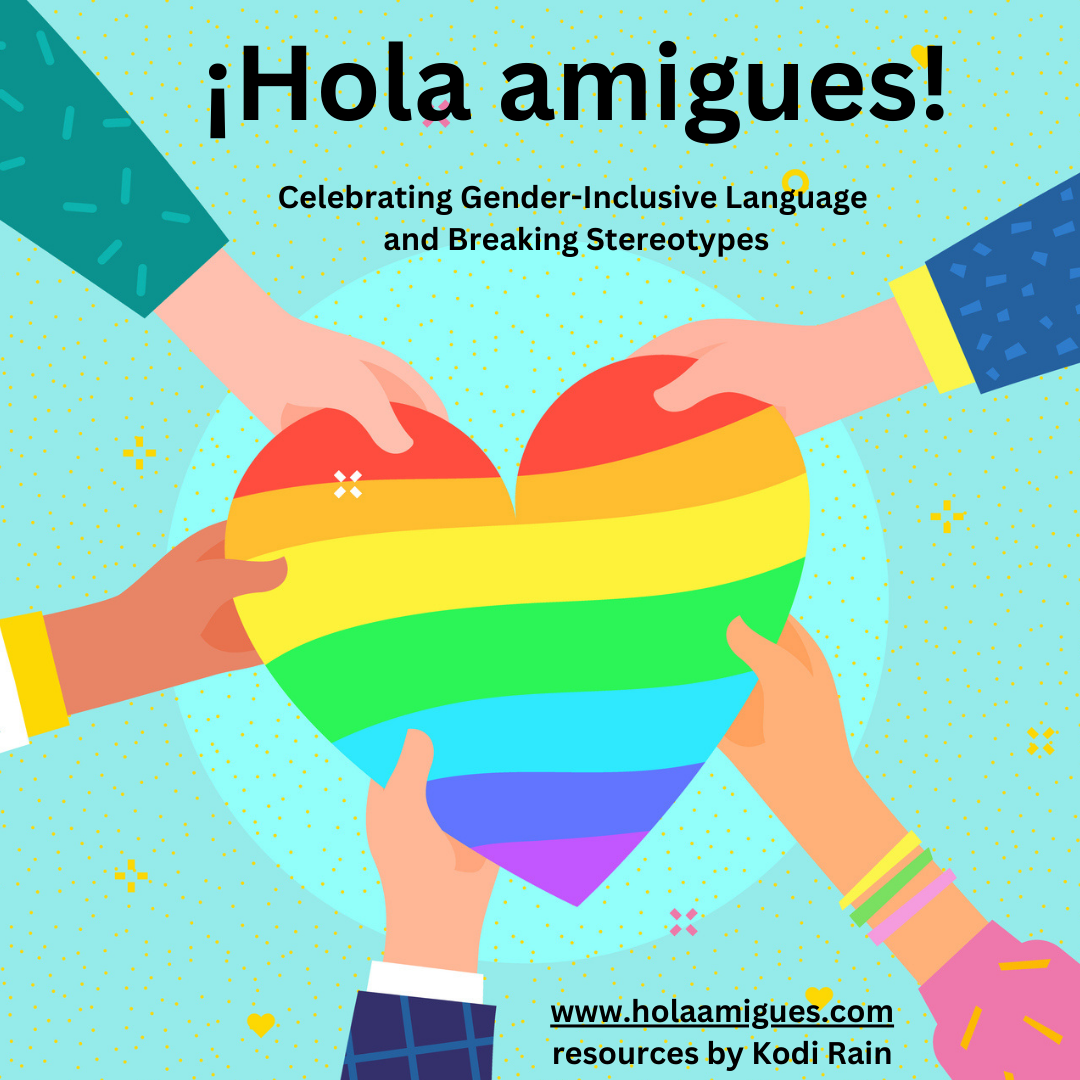
Kodi Rain (they/elle) teaches gender-inclusive Spanish to upper elementary and middle school students at a Montessori school. They are also the co-author of the first Spanish language reader written in gender-inclusive language, Los viernes de peliculas. I invited Kodi to provide their thoughts on selecting LGBTQ+ resources for the WL classroom. You are not going to want to miss their insights:


Check out Kodi’s site: holaamigues.com
“During my childhood and a good chunk of adulthood, I was starving for LGBTQ+ representation. I sought out any representation I could find, indiscriminately. Unfortunately I think the content that I ravenously consumed was detrimental to my psyche because of the stereotyping and subtle and not so subtle negative messaging regarding being queer. Just because a story involves LGBTQ+ characters, or any underrepresented population, does not mean it is helpful. I would say that the less representation there is, the more important it is that the representation be positive, non-stereotyping, and beneficial because when there is little representation, each one has more of an impact.
Queer characters and themes are often stereotypes. If you’re not sure how to choose queer resources or are unsure whether something is positive representation or might be problematic, that’s OK. Anti-bias education training teaches that we all have biases and it’s important to learn what they are so that we can stop perpetuating them. The following questions are meant to help you make thoughtful choices.
What does LGBTQ+ inclusion and normalization look like?
Often when there is a queer character there is a plot line about being queer connected to that character. There does not need to be. Seeing a queer character or, better yet, more than one queer character just living their lives and doing ordinary things normalizes queerness.
Also, a story doesn’t need to have queer characters to be inclusive. For languages that use the generic masculine any story can be gender-inclusive if groups of people of mixed or unknown genders are referred to with gender-neutral terms rather than the generic masculine.
GLAAD (Gay and Lesbian Alliance Against Defamation) article highlighting Los viernes de peliculas as a groundbreaking gender-inclusive book in Spanish
Is there a queer struggle trope or straight savior?
Avoiding stereotypes is part of being inclusive. Just like there are tropes regarding Latinas, Latines, and Latinos and Latin American countries, like poverty porn and the white savior myth, there are tropes regarding queer characters.
A very common trope is that the queer character is struggling with their identity or self-acceptance or some aspect of being queer and through the support of straight people, they find happiness. This reinforces the straight/queer power differential.
Try to choose stories where the queer character(s) is not struggling with some aspect of being queer and validation from straight people is not part of the development of the story.
Does queer = object of mockery or target of trauma?
Trauma porn is a common queer trope. There was an unspoken rule in Hollywood for decades that if a queer character was not an object of mockery, providing laughs, something bad had to happen to them. This was intended to demean queerness and the patterns still exist.
Is the predominant assumption of Cisgender / Heterosexuality?
Coming out stories had an important place in history when there was next to zero queer visibility in the media. They were the first and have been the most common story about queer people for decades. Unfortunately, these stories are reductive and don’t adequately represent our lives or our culture.
There are other problems with coming out stories too. If straight people don’t need to come out, why do queer people need to? The closet was created by straight culture and maintains the straight/queer power differential. Queer people are put in the closet, often throughout our entire lives, by binary and other rigid mindsets and the predominant assumption that everyone is cisgender and heterosexual.
Whose voice is telling the story and do they have lived experience and personal understanding?
Coming out stories, as they are often told, are about an internal struggle and the need for validation from straight people. They do not represent queer culture, but rather, portray a biased story of domination of queerness by straight culture.
These days, youth (and adults) with access to social media can connect and find community, as contrasted with coming out. That’s not to say that safety at home, school, work etc. and acceptance from family aren’t important. They are super important. And often they are not easy to come by..
We all want to feel accepted and safe, but the idea that a queer person is not being honest or can’t really be happy unless everyone knows and accepts their queerness is an oppressive concept. It is a concept created by privileged people who don’t understand code-switching.
In order to avoid the commodification of queer struggles, personal stories about discrimination or any queer plight are probably best coming from voices who’ve experienced them, rather than from someone who hasn’t.
Are queer characters “othered”, portrayed as inspirational just for living?
Inspiration porn is another trope. It’s an expression created by the disability community, like that someone who uses a wheelchair is “inspiring.” A queer character/person who is inspiring because they are living as a queer person might seem like a positive representation, and while it’s not directly negative, it’s othering and kind of patronizing.
To sum up: queer resources should include us, not commodify us. Look for stories where we are whole in our queerness, not struggling with it.
Please consider vetting the materials you use and if you do choose materials that perpetuate stereotypes, please consider discussing/critically analyzing the stereotypes with your students.
There is a need for more LGBTQ+ inclusive language learner readers and materials, which inspired me to write Los viernes de películas, my first foray into writing for language learners. If you identify as LGBTQ+ please consider writing LGBTQ+ inclusive readers. Thanks!”
The above is adapted from a Spring 2024 webinar with Kodi Rain and Maris Hawkins, How to Use Gender-Inclusive Spanish in the Classroom, offered through Team ¡Lo logramos! Notes and resources from that workshop can be found here.
For more ideas on how to create safe and inclusive spaces in your French classroom, check out this post.

Leave a Reply