


About three years ago, I attended a Story Listening workshop where Dr. Mason, the creator of Story Listening, said something that really stuck with me: “Teachers must become librarians”. I had never considered my role as a teacher in that light. I promised myself to investigate. Meanwhile there had been World Language teachers such as Mike Peto reporting success with their Pleasure Reading programs. So, how do we leverage the librarian in us and guide our students to read for pleasure?
Before guiding them toward independent reading, you must acquire books. To get you started, check out Fluency Matters, Fluency Fast, and this growing list of awesome independent authors. 8/28/2021 EDIT: Make sure to check out LLLAB and to investigate books before buying them.
And for French teachers, check out Stories First for free books.
First, let’s make sure everyone is on the same page:
What does a pleasure reading program look like?
- Student choose their own books
- Students read on a regular (daily) basis for a progressively greater sustained amount of time (5-10-15-…)
- Low or no accountability
- Low anxiety
- Students can abandon a book
Why have a reading program?
SSR = Sustained Silent Reading
- SSR programs establish a reading habit. (Pilgreen and Krashen 1993, Greaney and Clarke 1973)
- 90% of students actually read during SSR. (Von Sprecken and Krashen 1998; Cohen 1999)
- Those who read more read better. (Krashen 2004)
- Those who read more write better. (Krashen 2004; S.Y Lee 2004)
- Those who read more have more grammatical competence. (Y.O. Lee, Krashen, and Gribbons 1996)
- “Reluctant readers” are often those with little access to books. (Worthy and McKool 1996)
Source: Free Voluntary Reading, Stephen D. Krashen, 2011
The National Council of Teachers of English just updated their position statement on independent reading. Check it out!
How to guide emergent readers to find their home run book? Browsing strategies that work:
#1 Your book display


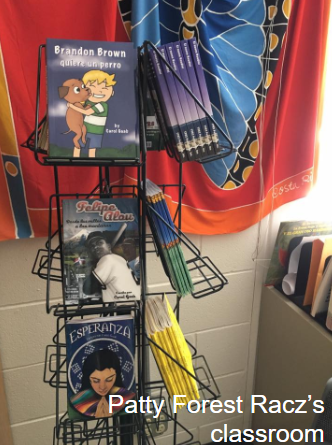
Thanks to Christy, Anne Marie, and Patty for sharing pictures of their classroom libraries on Facebook
- Consider patterns of traffic in your classroom and place books where students can see them
- Do not sort books by levels but by genres
- Book covers face forward so students can see them (and wonder…)
- Place your easiest books by the entrance to your classroom
Traveling teachers?
- Put velcro all over your cart to transform it into an ambulant library
- Ask the classroom teacher to let you put a few hooks in their classrooms, store your books in a hanging shoe organizer , and assign a student job to hook the book display up upon your arrival
#2 Choosing a book together


You are about to do a class novel… Why not let your students choose the book? Student choice, student choice, student choice, student…
#3 Book Talks
- Here is a book talk I did for Dr. Krashen’ Free Voluntary Reading book – for you, not for your students 🙂
- Here is a book talk by Teresa Torgoff in her French 3 classroom.
What I love about Book Talks is that you can do them any time! You see a kid lurk toward a book, do a book talk. A kid tells you she loves xyz, do a book talk about the book that has xyz in it, do a Book Talk every Friday or every day!
#4 Book speed dating


Setting-up for book speed dating
This is an old librarian’s strategy. When your students are ready to read books independently, book speed dating allows your students to browse a selection prepared by you.
- Prepare a selection of books, magazines, etc. for your students: a variety of genres you think your students will enjoy, make sure to have plenty of easy book in that selection, you want to make reading successful and pleasurable
- If you are desk-less, set-up your chairs in a circle
- Place a book under each seat
- Tell students they are going to get acquainted with some books from the classroom library
- Ask/Brainstorm with them how to choose a book that is right for them (look at cover, read summary in the back, see if there are pictures, how thick the book is, how difficult the book is, etc.)
- I usually tell my students about the five finger rule
- Give them this handout, prepared by Mike Peto, where they can record their observations about each book
- Now students can grab the book under their chair and browse it
- Every two minutes, ring the bell and invite students to pass their book to their left
- By the end of the period, they have a list of books and have an idea of which book they would like to try
- At this point, some students will ask “wait, do we get to read these books?” To which I answer: “Do you want to try?” “Yeah…” “OK, what do you think? Shall we read 5 minutes tomorrow at the beginning of class?”


Demonstrating a book speed dating at #TFLTA19
#5 Book rating
Once your kids are reading independently on regular basis, ask them to rate books as they finish them. I simply ask my students to place a star on the book cover poster on the wall if they liked the book. This is an effective strategy because other students see the starred book and that might become their next choice…


No free wall in your classroom? Use the hallway and make reading even more visible 🙂
#6 Literary circles
Sounds like a big word but for my newly independent readers, all I do is say “Time to put the books away. As you go back to your seats, share with someone about <where the story takes place> <your favorite character> <your favorite scene>, etc. This is a perfect brain break and enables students to spread the word about the book they are reading. Later, these can turn into full fledged literary circles in the TL.
I owe everything I do to encourage my students to read independently to three generous human beings:
- Claire Walter and her insightful blog
- Mike Peto and his book on Pleasure Reading
- Dr. Stephen Krashen and his books on Free Voluntary Reading